Posted by Greg Braun on Fri, Sep 30, 2011 @ 07:35 AM
As a dock or warehouse m
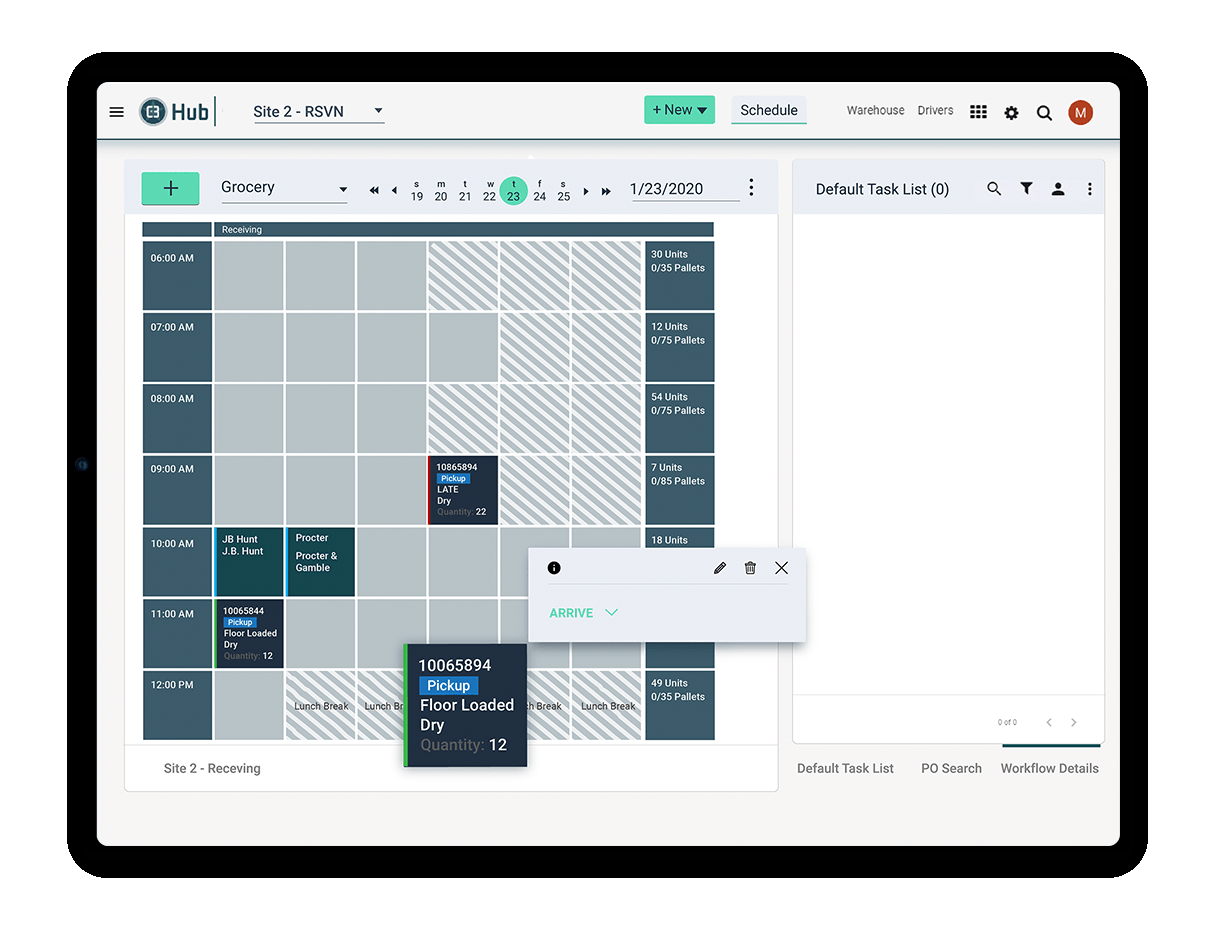
anager you already have an answer for these questions. You live with these issues on a daily basis. The real question is “how comfortable are you with your answers?” Your responses are based on the best information that you have at your disposal, which may not be accurate or optimal, but certainly are honest. If your operation used an automated dock scheduling system I can assure you your answers would be different.
The four questions listed below are a sample of some of the more prevalent issues that we encounter when talking with warehouse managers. I encourage you to read on to better understand the alternatives that are available.
1. Why are we paying driver detention to our carriers?
Knowing that there may be delays in your operation and that some drivers end up waiting more than they should, have you examined how high the numbers really are? Your carrier tracks precisely when drivers arrive, when they are unloaded and when they leave your facility. How can you verify that the carrier’s numbers are accurate? How do you know that the driver didn’t show up early for an appointment and that he isn’t making you pay for it? This is a tough question and a tough situation.
Delays may be unavoidable but are most often due to lack of planning. When the work day is properly scheduled based on the operation’s capacity, and drivers are made to respect their appointment times, delays are the exception and not the rule. Furthermore, accurate logs of driver arrival and departure times will easily validate driver requests for waiting time so you’ll understand exactly why you are paying detention fees.
2. Has the product for next week’s promotion been scheduled yet?
The only answer to this question is yes - because any other answer won't cut it. Furthermore, “not yet” means a lot of last minute shuffling of the schedule to ensure that you can accommodate that featured product. In the worst case you will just bring them in and pay the consequences - be that in overtime or carrier detention.
Everyone tries to reserve space in the schedule for promotional product; however few know how to effectively manage this? An automated system allows you to reserve capacity for promotions and alert you when things don’t go as planned. In addition, carriers jockeying for the preferred time slots will be better managed with an automated system; allocating time slots based on the needs of the business versus the carrier’s.
3. Why are we spending so much on dock overtime?
You may have been able to negotiate your way out of paying driver detention, but that won’t happen with your dock staff. You know the root cause is the same as with driver waiting, but where do you start to solve it?
A dock scheduling system allows you to build a schedule based on your labor capacity. That also means that you can distribute those difficult to handle loads across a shift to maximize productivity. For example, you may want to limit the number of non-palletized containers that are received or restrict these loads to the beginning of the shift. In the worst case, when you know that higher volumes are expected, you can pro-actively bring in more staff and avoid overtime premiums. This will dramatically reduce your need for overtime; limiting the expense to the infrequent and justifiable occurrences.
4. Why aren't we scheduling our carriers over the internet?
This question comes from that new hire that just finished school. It only seems normal that carriers should be able to make their appointments over the web rather than call someone at the warehouse. This is a serious question and the answer of “I don’t know about that internet thing” doesn’t cut it anymore. Your key people are spending hours answering phone calls, emails and faxes and in this day and age it just doesn't seem right.
Honestly, you also would like to have an answer to this question, but you know that the guys in IT are already over worked and the budgets have all been exhausted.
The good news is that there are powerful cloud computing solutions out there for dock scheduling that are easy to implement, easy to integrate into your operation and don’t cost a fortune. Not only are they reasonably priced, but the direct savings incurred should more than compensate implementation and operating costs of such a solution. You will be surprised to know that getting a better grasp on these questions isn’t that complicated. To get started on informing yourself on the available options, sign up for a free WebEx demonstration of C3 Solutions dock scheduling system - C3 Reservations.
Posted by Greg Braun on Tue, Sep 20, 2011 @ 01:50 PM

As a provider of a
dock scheduling solution, we experience many different approaches to managing the traffic in and out of the distribution center. Each operation has its own unique set of challenges and consequently unique problems. Most of the operations that we come across are very manual – the closest thing to an
appointment scheduling system is usually a colourful spreadsheet or that antiquated green screen.
Surprisingly, most operators don’t believe that they need a system because they don’t recognize the real cost of these problems or they don’t believe that there are solutions out there that can help without breaking the bank.
As the saying goes: “The first step to solving a problem is admitting you have one”. If any of these five warning signs describe your operation you may want to start looking for help. So in no particular order here they are:
1. Your Key Warehouse Staff are Always on the Phone with Carriers.
- If you are taking appointments today from your carriers and you don’t have an automated system you are running a mini call center. A lot of companies have reduced the number of calls with email or faxes but these are still very time consuming activities that keep your key people from doing the real job that you hired them for.
- Not only do they take calls from carriers and update that colourful spreadsheet, purchasing is calling on a regular basis to make sure the vendors involved with that big promotion is following through on their commitment.
2. There is a Regular Line up of Trucks Outside your Warehouse.
- At a certain point, security just won’t let drivers into the yard. This can be a result of carriers not respecting their appointments or just showing up without one. Another cause to this problem is that the operation is behind schedule because the driver didn’t have payment for the unloading service, or maybe the vendor didn’t load the trailer as the buyer requested making it difficult to unload.
- Regardless of the cause, this problem can result in detention charges from the carriers and potential legal problems with local authorities.
3. The Product You Need Never Seems to be Available.
- How do you make sure that the product involved in that important promotion is given top priority?
- It’s a challenge and to pull it off it involves a lot of last minute changes to the schedule, extra phone calls and emails and overtime on the dock.
4. You’re Paying Too Much Overtime to Your Dock Workers.
- It’s the end of the day and the product absolutely needs to get unloaded and received today! Management will approve the over-time and other charges but you know it’s due to poor planning and scheduling!
5. You Spend Hours Compiling Reports.
- You can’t improve something you can’t measure. Measuring on-time delivery and other vendor compliance metrics are extremely labour intensive. Are you like most operations that end up spending one day of the month just compiling reports? To add insult to injury, most of these reports are based on data that is usually inaccurate or incomplete and therefore easily contested by the carriers or vendors.
Light at the End of the Tunne
l
The good news is that it is much less painful to implement a solution than to continue to live with the problem. An appointment scheduling system can help you build a plan that fits your operation, execute the plan, automate the communication and allow you to measure everything related to that schedule, including vendor and carrier compliance. If you would like to have a live demonstration of a web-based appointment scheduling system, contact us for a web demonstration of our system - C3 Reservations.
Posted by Greg Braun on Mon, Feb 14, 2011 @ 05:03 AM
I’m sure there are days when your warehouse feels like a call center. Whether it’s the busy season or the promotion of the month, carriers seem to be constantly calling to negotiate appointment times. What was a manageable situation a few years ago has morphed into a full time job for several of your key warehouse staff.
Product has to Ship
Carriers and suppliers are under pressure from the buyers to make sure their product gets to the warehouse on time. So not only are you taking the carriers calls but that frazzled purchaser is calling to see if the carriers have made their appointments – it goes on and on. I won’t even mention those last minute changes that get made to the schedule and need to be communicated to everyone.
So what do you do? Senior management doesn’t believe the problem warrants the attention of IT, but yet we all know if the product doesn’t ship you have a major problem.
Managing warehouse arrivals and departures is not as easy as it sounds. The business needs the product (certain products more than others), the suppliers need to ship their product (so they can get paid) and the carriers want to make sure that you don’t un-necessarily delay their drivers (so that they can generate revenue by driving). So while it makes sense that all of these competing needs generate a lot of phone calls, emails and faxes, all parties would agree they have better things to do.
There is a Better Way
The good news is there are solutions out there that can make your life easier. Obviously if you can book a flight, a rental car and a hotel room without ever speaking with someone you would like to think that a carrier can book an appointment at a warehouse via the internet – well they can.
On-demand appointment scheduling systems exist that allow your business to provide a web portal to your carriers and suppliers that will eliminate all of the phone calls, emails and faxes. Carriers can be offered time slots that respect the buyers requested date, fulfill the businesses need for the product and respect particular constraints that the warehouse might have. Even better news is that this can be all done without any IT involvement and at a budget that makes sense.
Now if your not ready to implement a full blown system there are some simple techniques that might help to reduce your number of calls. Have your IT department create an email address such as appointments@yourcompany.com and make sure that you, and everyone handling appointments, receive emails sent to this address. Advise carriers and vendors that all correspondence regarding appointments will be done using your email address and stop answering the phone. Obviously this won't eliminate emails, however, by focusing all correspondence to email will definitely help.
Find Out More
So while maintaining an open dialogue with your carriers and suppliers is important let’s not have too much of a good thing. If you would like to get a hands-on demonstration of how a Dock Scheduling System can help improve your communcations with carriers and suppliers contact us for a web demonstration of our C3 Reservations product.
Posted by Greg Braun on Tue, Sep 21, 2010 @ 07:11 AM
Canadian Tire Corporation (CTC) has successfully upgraded to version 4.0 of C3's Yard Smart yard management system. Version 4.0 signifies a major milestone in the progression of C3's yard management solution.
Software Agents make the Yard Smarter
Yard Smart V 4.0 represents C3 Solutions first implementation and utilization of multiple software agents. A software agent is a convenient and powerful way to describe a complex software entity that is capable of acting with a certain degree of autonomy in order to accomplish tasks on behalf of its users. At CTC, Yard Smart’s Shipping Agent, Receiving Agent, Transfer Agent and Empty Trailer agent all work in concert to ensure that the appropriate trailers are always available to the business so that shipments to the retail stores are not delayed.
For example, in the greater Toronto area CTC manages in excess of 3.5 million square feet of warehouse space, 450 dock doors and more than 5,000 trailers and containers at any given time and, therefore, ensuring each operating area has just the right amount of yard resources available was a real challenge. With Yard Smart V4.0 software agents do the work automatically. If a specific operation is short of empty trailers, the Empty Trailer agent will either communicate with the Receiving agent to increase the priority of certain trailer unloads or it will communicate to the Transfer agent to shuttle empty trailers from off-site yards. This is all done without human intervention.
"Over the last five years C3 Solutions has become a valued business partner for Canadian Tire” says Gary Fast, Associate Vice President of Domestic Transportation Operations. “Given our unique operating environment, yard management has always been a challenge for us. Together with C3, CTC has been able to deliver on our supply chain objectives - to better serve our expanding retail network."
Enhanced Business Intelligence
In addition to the implementation of software agents, Yard Smart V 4.0 also includes new features to manage large national fleets through the use of decentralized regional servers, enhanced business intelligence through it’s new data store functionality and the implementation of web services that provides expanded integration capabilities to external business systems.
“C3’s primary focus has always been to find the best solution to our customer’s business issues as they pertain to yard management. Innovative technology like software agents are simply a means to that goal” claims Nicholas Couture President and Chief Technology Officer at C3 Solutions. “C3 is proud to have built a valued relationship with a world class retailer like Canadian Tire.”
About Canadian Tire
Canadian Tire Corporation, Limited (TSX: CTC.A, CTC) operates more than 1,200 stores, gas bars and car washes in an inter-related network of businesses engaged in retail, financial services and petroleum. More than 57,000 Canadians work across the Canadian Tire organization from coast-to- coast. Canadian Tire Retail and its Associate Dealers together form one of Canada's best-known and most successful retailers with 476 stores in communities nationwide. Canadian Tire stores offer a unique mix of products and services through the leadership of three specialty stores under one roof - Automotive, Sports and Leisure, and Home Products. Canadian Tire also offers customers the opportunity to research over 25,000 products online at www.canadiantire.ca and order items by phone order at 1-866-746-7287.
Learn More About Yard Smart Version 4.0
If you would like to learn more about how Yard Smart V 4.0 can improve your yard operations and increase your warehouse throughput, please contact us for a free web demonstration.
Posted by Marc Tomkinson on Thu, Jul 29, 2010 @ 08:19 AM

Over the years, I've been on dozens of
yard management deployments in varying types of operations around the world. One factor that has often caused some trouble is the 'buy in' from the switcher drivers in the yard.
"We know how to run our yard"
I've heard this quote from switcher drivers during go-lives way more than I care to remember - and up to a certain extent, it's true. Switchers, shunters, jockeys, whatever you call them, are your resources which are in the best position to manage your yard. They take pride in managing the trailers and keeping the yard organized and the dock doors filled with the appropriate trailers.
So how exactly can a business get their switchers to hop onto the yard management system (YMS) band wagon and actually become an asset in their system deployment rather than a hindrance? I've come to realize that there are three factors that can influence how your switchers will contribute (or not) to the implementation of a YMS.
1. Show Switchers How YMS Makes Their Jobs Easier
Switchers are often very concerned with the arrival of a yard management system. They feel their jobs are at risk or that Big Brother Boss wants to pry into their work. This often couldn't be further from reality. Many businesses opt for implementing a YMS system because their operations has grown to a point where managing the yard using classic methods simply doesn't cut it anymore. Paper-pencil, magnet boards, spreadsheets, all these methods prove themselves to be insufficient. The point a business needs to make with its switchers is that they are implementing the system to make them and the warehouse more efficient by automating some or all of the yard business processes. Switchers can then concentrate on the core of their jobs and perform to their maximum potential and do what they do best - drive trucks.
2. Build and Design The Solution with The Switchers
Who's going to be impacted most by the implementation of a YMS in your operation? Transport personnel, receiving/shipping personnel and switchers. We often see transport, receiving and shipping personnel involved at all levels of the project, from the initial scoping to the solution design, but we very seldom see switchers in these meetings. Well, they are probably the people whose jobs are impacted the most in this project and should absolutely be included when defining the scope and future processes. A user that 'owns' the system is definitely more likely to be motivated and excited about the new implementation. This motivation will trickle down on other members of the team and make for a much smoother transition. Not only that, switchers know best how their yard is maintained. I've sat in meetings trying to define 'what goes where' in the yard and no one in the operations can tell me precisely. Switchers have a better chance of getting things right the first time.
3. Listen to Shunter Feedback When Rolling Out
Regardless of how well you plan and setup your system, there will be some tweaking needed when rolling out. Trailers will be sent to the wrong areas of the yard and the first people to realise this will be the switchers/shunters. Listen to them. They have relevant input and they provide it in real-time as the issue is occurring. It’s then very easy to adjust the configuration of a system right on the spot. Next time this situation occurs, shunters will notice that the feedback they provided was implemented in the system and they'll feel like they are gaining control over their yard, not losing it to a new system.
In the end, the successful deployment of any major piece of software in the supply chain requires the involvement of many different departments. Like in a real chain, if one of these links is weak or breaks, you run the risk of losing control over what you're attempting to achieve. It's important to have switchers involved as much as possible in the implementation of yard management software and if you do, you're already that much closer to a successful deployment.
Get Started with The Right Product
Now that you know a few things about how to implement a yard management project, the next step is to select the right software product. To find out why top companies have selected C3 Yard Smart, register for a free WebEx demonstration.
Photo is courtesy of Biglorryblog.
Posted by Greg Braun on Mon, Jun 21, 2010 @ 11:49 AM

KeHE Distributors, a leading distributor of more than 40,000 natural and specialty food items, has deployed C3 Reservations in nine distribution centers throughout the US.
Dock Scheduling with a Rapid ROI
When KeHE Distributors decided to improve their inbound appointment scheduling processes, they had several key criteria by which to evaluate the different solutions on the market.
"We needed to improve the productivity of our schedulers, streamline our receiving of carriers at the facilities and provide better visibility on the status of purchase orders throughout the enterprise", said Craig Turner Vice President of Distribution Operations at KeHe Distributors. "Our industry is very competitive and we needed a system to be functionally rich and easy to deploy at a cost that reflected our situation."
C3 Reservations on-demand software fit the bill. On-demand software reduces a company's total cost of ownership by eliminating on-site servers and the associated IT costs. Furthermore, C3 Reservation's volume based cost model means companies pay for a solution that reflects the size of their operation - not the size of the software.
C3 Reservations optimizes the receiving and shipping process by scheduling appointments to the available capacity in the warehouse. Operators can simply apply relevant constraints to ensure that the warehouse receives a balanced schedule that streamlines the operation. C3 Reservations reduces phone calls, faxes and manual emails that are involved with the traditional back and forth of appointment scheduling.
KeHE piloted the application at one of their busiest warehouse as a proof of concept, after which they rolled out 8 additional sites in a period of 4 weeks and have recognized significant savings. "We have increased the productivity of our schedulers by 50 percent and our receiving at the warehouses has been streamlined and simplified. We now have a standardized appointment scheduling process that is uniform across the business.", says Turner.
"C3 Reservations is a robust application that responds to industry requirements. Companies are looking for an easy to implement, low cost appointment scheduling solution that doesn't require involvement from their IT departments.", remarks Greg Braun Vice President of Business Development at C3 Solutions. "C3 is committed to providing high quality On-Demand software for areas of the supply chain that have traditionally been overlooked. The success experienced by companies such as KeHE demonstrates that there is a legitimate need for these types of solutions."
About KeHE Distributers
KeHE Distributors is a leading distributor of more than 40,000 natural and specialty food items that fit the lifestyle of today's consumer. KeHE distributes its huge product line--including specialty, gourmet, natural and organic, Kosher, international and ethnic food products--to retail grocery stores of all sizes in 49 states as well as Mexico and the Caribbean. KeHE, an employee-owned company, was founded in 1952 by Arthur Kehe.
Learn More about C3 Reservations
If you would like to learn more about how C3 Reservations can increase your schedulers productivity and increase your warehouse throughput, please contact us for a free web demonstration.
Posted by Mark Stanton on Mon, May 03, 2010 @ 01:52 PM
In my last post I indicated some of the tangible benefits associated with yard management as a means of answering the question "Is Yard Management Important?". These benefits are real and sufficient to justify a project by themselves. However these benefits are only half of the equation.
Better Information the Key to Improved Operations
Information is the life blood of every business and I am sure that your business knows the important KPI's from the WMS e.g. cases picked per hour etc. or the PoS system can provide the average basket size of every shopper and so on.
But does your business know the KPI's for the yard operation or how the yard truly affects the rest of the operation? If not, then you may not know that a problem exists. You could be throwing good money away and have no idea.
For example; one of the metrics that retailers use is on-time delivery of trailers to the stores. In particular this metric is crucial during peak seasons. If product cannot get to the stores in time sales are lost. Furthermore if work crews are idle at the store waiting for the trailers, productivity is lost.
One of our customers was convinced that their warehouse was running at capacity during their seasonal peaks before they implemented a yard management system. All of their previous statistics showed that trailers were being brought to the doors on time but yet the warehouse was not able to load the trailers in a timely manner; this was a major issue for the retailer and seemingly not a yard problem.
After implementing Yard Smart the warehouse throughput increased by 12.4% during the seasonal peak. Further analysis showed that the increase in productivity wasn't achieved by processing more trailers, but by processing the right trailers. The inventory visibility that the yard management system provided enabled the operation to prioritize the unloading of trailers that contained inventory required for outbound loads. Also, dock productivity was increased by avoiding the congestion caused by handling inventory which was not needed for the outbound operation.
Bottom line - more products were shipped and sold with the same amount of resources.
So back to my original question: "Is yard management important?" As some of you have commented on part 1 of my posting, this is a contextual question. There needs to be a minimum operational volume to be able to justify a specialized solution for the yard. I wish I could tell you what that volume is, but this also is very dependant on the specific operation. That being said I hope you agree that the information provided by a yard management system is important and is essential in improving your supply chain operation.
Find the Unexpected Returns
If you would like to get more information on how other companies have gained unexpected benefits from a yard management system, please download our case study on a major European retailer and their experience with yard management or contact us for a demonstration of our yard management system - C3 Yard Smart.
Posted by Mark Stanton on Mon, Apr 26, 2010 @ 09:09 AM
Is yard management important? It is a question that I ask on many occasions and, depending on whom you ask, you could get a response similar to the ones below:
- Yard Management is not important enough to invest the time/money/resource in.
- Yard Management is important but it is not a priority at the moment, we have too much else to do.
- Yard Management is probably more important than we know, we just can't prove it to the powers that be.
- Yard Management is vital; we could not run our business without it.
So, I decided to write this blog and ask you some questions to see if yard management is actually important or not.
Given our current economic context, every business that has a supply chain operation has looked at the warehouse operation and transportation fleet to see where costs can be saved and/or efficiencies improved. How many of these companies have looked at the yard in the same way? Not too many in my opinion. Why is that?
Yard Management is the invisible link between the warehouse or cross-dock and the transportation fleet. It is the last "yard", so to speak, between these two operations and unfortunately is not always an integral part of a supply chain operation.
Now, if I told you that there is money to be saved by implementing yard management you would immediately think "of course he would say that, he sells yard management" which is a fair point. But let me give you some food for thought.
Benefits and Payback - "what is the ROI?"
To be honest, this is the toughest question to answer because every business is different. But, there are a number of things that should be considered when looking at ROI.
Shunter costs: i.e. fuel, maintenance, lease costs, and the driver(s).
Do you know what you spend on this? What would a 13% or 22% saving be to your operation? What would the impact be to your business if you could get 2-3 more moves an hour/per shunter? Yard management has proven to improve shunter efficiency by 29% to 38%. What impact would this have on your company's bottom line?
Trailer utilization: how quickly can you ‘turn' a trailer from inbound to loaded and ready for dispatch?
How much time does it take for your business to gate-in and gate-out a trailer, 4-5 minutes or more? What would you do if this could be 20-30 seconds? How many trailers could you eliminate from your operation? Would you need to rent/lease trailers for peak trading periods? Yard management and dock scheduling could reduce the number of trailers your business needs to meet today's operational requirements by 3% - 11%. How much could you save?
All of the above are immediate, quantifiable and tangible benefits. Real money!
However, I believe the above is only half of the benefits available when implementing yard management. In my next posting I will discuss some of the success stories that companies have had by extending visibility past the four walls of the warehouse. These benefits are usually substantial and are often difficult to predict.

Judge for Yourself
In the meantime if you would would like to have a demonstration of how a yard management system could provide value in your operation. Please contact us for a brief web demonstration of C3 Yard Smart.
Posted by Greg Braun on Tue, Mar 16, 2010 @ 01:10 PM
I recently attended the C3 European User Group meeting and I have to say it was a great opportunity to hear about the challenges facing yard operators from all sorts of different industries. While many varied topics were discussed there seemed to be a re-occurring sentiment that presented itself: that people who manage yards don't feel they are given the respect and support that other operating areas of their companies receive. Now, at first, I found this somewhat trivial and even amusing but the more I thought about it the more it seemed to be a legitimate concern.
It is safe to say that nobody builds a yard. Companies build warehouses, distribution centers, manufacturing plants, cross docks - but no one builds a yard. The yard is a piece of real estate that is included with all of these facilities as a necessary element to support the buildings - just like the employee parking lot. In the perfect world trailers arrive, they are brought to a dock door, they are loaded or unloaded and then they leave. The important business is done within the four walls!
With this perspective it becomes easier to understand why yard managers often feel like the forgotten "step sister" of their operation. So what needs to happen to resolve this predicament? How can we improve the profile of yard management in the supply chain and ultimately add more value to the operation?
I don't think there is one right answer to these questions, however, I can outline some of the best practices that I have seen some of our customers implement that are very successful.
3 Steps to Better Understanding the Importance of Yard Management in your Operation
1. Clearly define the yard processes. While this may seem obvious the key word here is clearly. I distinctly remember visiting a prospective customer to better understand their yard processes. I was expecting to see a typical simple process flow diagram but, to my surprise, the yard processes spanned the entire wall. It was clearly understood how each distribution function affected the yard and what operations were at risk if the yard failed.
2. Establish Key Performance Indicators (KPI's). Examples of important KPIs are, the time it takes a trailer to be brought to a door once it has been requested by the warehouse; the percentage of trailers that leave on time from the warehouse on their outbound trips; total number of trailer moves performed by driver by shift; trailer utilization etc.. Defining KPI's and then continuing to measure them will help improve the visibility, and importance, that the yard plays in the operation.
3. Allocate sole responsibility for the operation of the yard. Without a doubt, all of our customers that have a dedicated team in charge of the operation and performance of the yard have experienced superior results. That being said if your operation is not significant enough to warrant a dedicated team or person, there needs to be one team or person that is responsible for the yard. Again this may seem obvious; however, sometimes the obvious things are things we tend to take for granted and consequently don't do them.
This is by no means an exhaustive list, so please feel free to contribute your comments on other steps that you believe are necessary to increase the profile of yard management within the organization. I sincerely believe that companies that do not recognize the importance of yard management are denying themselves the opportunity to improve their supply chain operations.
Ultimately, yard management has to be something that the organization believes is worth the investment. I previously wrote a white paper which documents some of the challenges in establishing a return on investment in the yard. I invite you to download this white paper to further explore this challenging subject. You can download the white paper here.
Posted by Greg Braun on Sat, Feb 20, 2010 @ 02:07 PM
Welcome to C3 TV. In our first episode Mark Stanton of C3 Solutions discusses some of the current applications of RFID and how RFID can be applied to yard management. In particular Mark summarizes his discussion by outlining the six steps necessary to evaluate if RFID is right for your yard management solution.
Six Steps to Evaluate if RFID is right for your Yard Management Solution
- Ignore the technology. This is a tough thing to do but the details of a specific technology are the wrong place to start when looking for operational improvements.
- Concentrate on defining the problem that you want to fix or the operational process that needs to be improved. Clearly define what you want to achieve, there by establishing the objectives of your project.
- Design the solution that fits your objectives. This might result in a requirement for a technology, such as RFID, or strictly a software based solution without any additional hardware requirements. Finally it may lead to making process changes that don't necessitate an automated system at all.
- Evaluate all of the different technology options out there such as RFID, GPS, bar coding etc. (the options are endless). Once your objectives have been properly defined the right solution will become more apparent.
- Talk with different potential suppliers that don't have a vested interest in promoting a specific hardware solution. Try and identify suppliers that provide solutions that are "hardware agnostic" and that have a track record that supports their approach.
-
Lastly, talk with companies that have implemented yard management systems. Establish best practices from companies that have successfully deployed yard management and focus on the real system benefits.
Take a Yard Smart Test Drive

Contact us for a web demonstration to find out how C3's awarding winning Yard Smart system can benefit your operation.